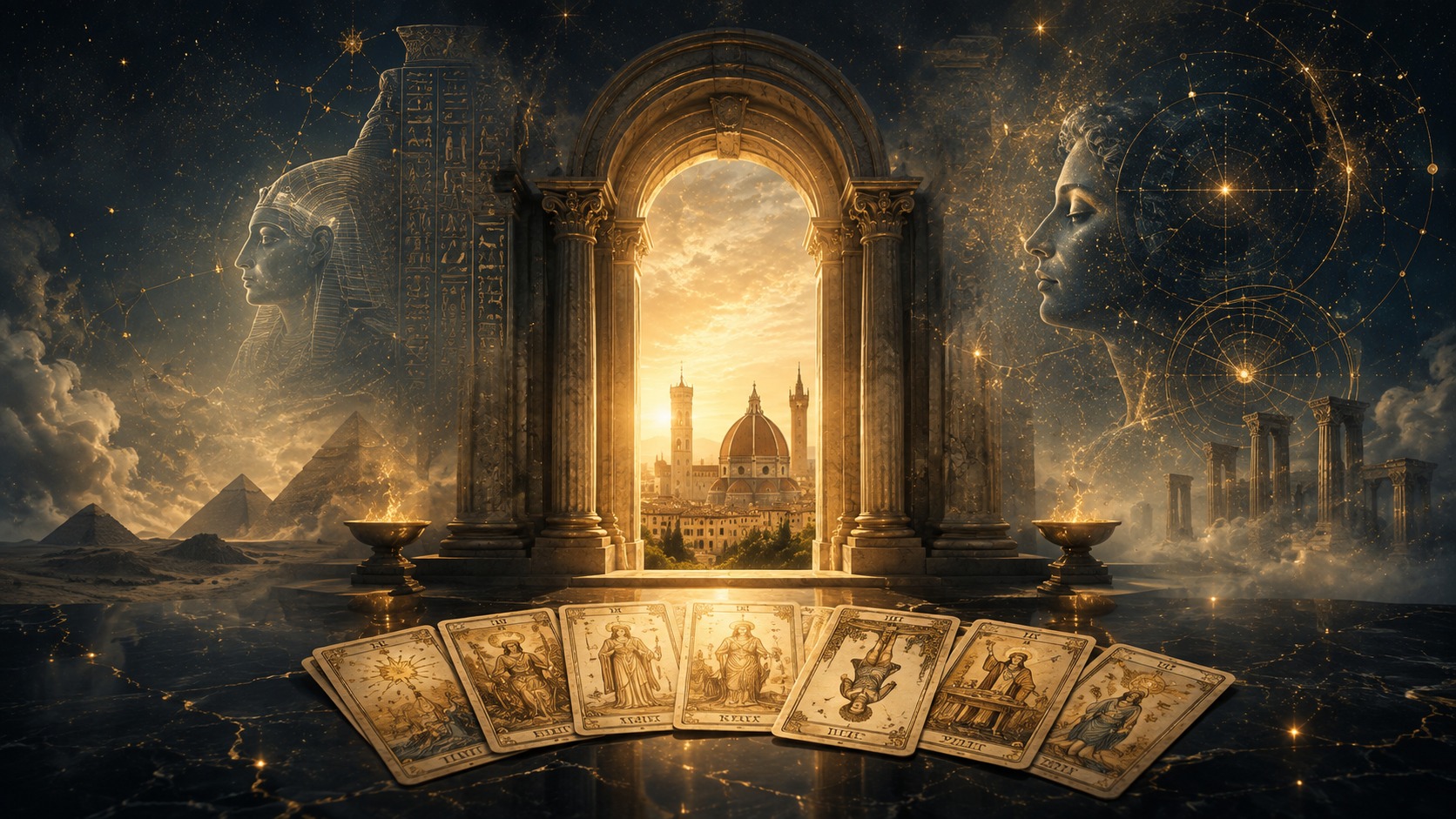
If you are asking where did tarot come from, the documented answer begins in fifteenth-century northern Italy, not in pharaonic Egypt. The real tarot cards origin is Renaissance Europe. For roughly three centuries, tarot was primarily a game. Only later, especially in eighteenth-century France, did occult writers and professional cartomancers transform the deck into a systematic tool for divination.
That does not make tarot less meaningful. In fact, the real story may be more interesting than the legend, because it shows how a symbolic system can accumulate meanings over time until those meanings become inseparable from the way people experience it.
Are tarot cards from ancient Egypt?
The earliest surviving tarot cards belong to Renaissance Italy. The Metropolitan Museum of Art dates the famous Visconti-Sforza Tarot to shortly after 1450 and describes tarot in this period as part of European playing-card culture. The earliest references cluster around northern Italian courts in the fifteenth century.
The imagery also makes sense in that environment. Traditional tarot includes figures such as the Pope, the Popess, the Emperor, Christian virtues, Judgment and the Devil. The card later renamed the Hierophant in some occult decks was originally the Pope. These images belong to medieval and Renaissance European religious and political culture, not to a preserved pharaonic priesthood.
So, are tarot cards ancient? The cards are old by modern standards, but not ancient in the historical sense. Their documented history is about six centuries old, not several thousand years old.
Who invented tarot cards?
There is no single known inventor of tarot cards. Tarot developed out of European playing-card culture in northern Italy during the fifteenth century. Standard suited cards were supplemented by a special sequence of picture trumps and a Fool, producing the structure that later occultists would reinterpret as the Major and Minor Arcana.
One of the best-known surviving groups is the Visconti-Sforza Tarot, made for Milanese elites around the middle of the fifteenth century. These were luxurious hand-painted playing cards. There is no evidence that the people who commissioned them regarded them as an Egyptian oracle or a secret esoteric book.
The Tarot de Marseille also came later than tarot itself. It became one of the most influential standardized patterns in France, but the name does not mean tarot originated in Marseille. Earlier Italian and French decks already existed. Marseille became an important center of tarot-card production, which is why the pattern eventually became associated with the city.
When were tarot cards first used?
Tarot cards were first used as playing cards in the fifteenth century. For centuries, that was their primary documented function.
There are signs that divinatory practices involving tarot existed before the great French occult systems of the late eighteenth century, including evidence from Bologna. For that reason, it is safer to say that tarot spent roughly three centuries primarily as a game rather than claim that nobody had ever experimented with divination before France.
The decisive change came in 1781, when the French-Swiss scholar and pastor Antoine Court de Gébelin published an essay on tarot in Le Monde primitif. He argued that the deck preserved ancient Egyptian wisdom. An accompanying essay by the Comte de Mellet pushed the association further, linking tarot with the Book of Thoth and with fortune-telling.
The problem is that these authors did not have historical evidence for an Egyptian origin. Court de Gébelin was writing decades before Egyptian hieroglyphs were successfully deciphered. Jean-François Champollion's major breakthrough came in 1822. The Egyptian-language etymologies invented around tarot in the eighteenth century therefore had no solid linguistic foundation.
The Egyptian story was historically wrong, but culturally powerful. It changed the question from ‘What game is this?’ to ‘What secret knowledge might this deck contain?’
How Etteilla turned tarot into a divination system
Jean-Baptiste Alliette, better known as Etteilla, is the key figure in the next stage of the history of tarot cards.
Etteilla did not suddenly discover divination inside a tarot deck. He was already a cartomancer. In 1770, more than a decade before Court de Gébelin's Egyptian theory, he published a method of fortune-telling with ordinary playing cards. His system already assigned specific meanings to cards and distinguished between upright and reversed positions.
After the Egyptian interpretation of tarot appeared, Etteilla applied his existing cartomantic framework to tarot. Between 1783 and 1785 he published Manière de se récréer avec le jeu de cartes nommées Tarots, a systematic method of tarot reading. Material associated with his Livre de Thot tradition in the 1780s represents one of the first attempts to design tarot explicitly around divination rather than around play.
So Etteilla did not invent tarot cards, and he did not invent the original game. His historical importance is different: he helped turn tarot into a structured divinatory technology. He took a European card game, combined it with existing cartomancy and the new Egyptian-occult mythology, and created a method readers could actually use.
Why reversed tarot cards do not simply mean the opposite
Etteilla's earlier cartomantic system already treated orientation as a way of giving a card another semantic state. A reversed card could have a different meaning without being the logical negation of the upright meaning. Reversal expanded the vocabulary of the deck; it did not merely create a positive/negative switch.
A later example makes this especially clear. In A. E. Waite's Pictorial Key to the Tarot, the Wheel of Fortune upright is associated with destiny, fortune, success, elevation, luck and felicity. Reversed, Waite gives increase, abundance and superfluity. That is not the opposite of luck or success. It is a different interpretive field.
The Hierophant provides another example. Waite's upright meanings include marriage, alliance, captivity, servitude, mercy, goodness and inspiration. Reversed, he gives society, good understanding, concord, over-kindness and weakness. Once again, the reversal does not simply negate the upright card.
This matters in practice. If a reader assumes that every reversed card means ‘the opposite,’ the reading becomes much flatter than the historical systems that helped establish reversals in the first place.
Depending on the tradition, a reversed card can indicate a distinct meaning, an excess, a distortion, a delay, an internalized expression, a blockage or something else entirely. The important point is that reversal creates another state of the symbol; it is not automatically an antonym.
From Egypt to Kabbalah: Éliphas Lévi changes tarot again
The nineteenth century added another major layer. French occultist Éliphas Lévi connected the twenty-two tarot trumps with the twenty-two letters of the Hebrew alphabet and integrated tarot into his interpretation of Kabbalah, ceremonial magic and Western esotericism.
This was another historical construction rather than the recovery of a demonstrably ancient tarot doctrine. But it was enormously influential. Tarot was becoming a framework capable of absorbing other symbolic systems: Hebrew letters, planets, zodiac signs, elements and mystical diagrams.
That flexibility is central to understanding why the tarot cards origin and the later history of tarot can look so different. The deck began as one thing and became another because generations of readers kept building correspondences around it.
The Golden Dawn and the tarot most people know today
By the late nineteenth century, the Hermetic Order of the Golden Dawn in Britain developed an elaborate network of tarot correspondences involving astrology, Hebrew letters, Kabbalah, elements and ceremonial magic.
Arthur Edward Waite and Pamela Colman Smith both moved through that esoteric environment. Their Rider-Waite-Smith deck, published in 1909, became one of the most influential tarot decks in the English-speaking world. One of its major innovations was the use of fully illustrated scenes throughout the numbered suit cards, making the Minor Arcana much easier to read visually.
By this point, tarot had accumulated several historical layers: Renaissance Italian gaming, eighteenth-century French Egyptian speculation, Etteilla's cartomancy, Lévi's Kabbalistic correspondences, Golden Dawn occultism and the visual language of Pamela Colman Smith.
A final reflection: when does a symbol become real?
There is a final question that history alone cannot answer.
If tarot cards work as archetypal symbols, perhaps their power does not depend on every meaning having been present at the moment the cards were first created. An archetype can be understood as a container inside a larger symbolic system: an image that becomes linked, through repetition and experience, with patterns of human life.
From a psychological point of view, we could say that meanings become culturally encoded. From a metaphysical point of view, we can go further: perhaps a meaning repeatedly assigned to a symbol becomes encoded into the texture of the system in which consciousness operates.
Seen this way, it is not necessary for reversed cards to have had divinatory meanings in fifteenth-century Milan. Once readers introduced those meanings, used them consistently, experienced them in readings and transmitted them across generations, the meanings became part of tarot's symbolic reality.
The same could be said of the Egyptian layer, Kabbalistic correspondences or modern interpretations. Historically, we can identify when they entered the tradition. Symbolically, once a correspondence is deeply established, it can begin to function as though it had always belonged to the language.
That may be the deeper lesson hidden inside the real history of tarot cards. A symbol does not need a fabricated five-thousand-year pedigree to become powerful. Meaning can accumulate. It can be reinforced. It can become archetypal within the system that uses it.
Tarot becomes no less mysterious when we discover that it was not ancient Egyptian. It simply becomes mysterious in a different way.
Sources
- The Metropolitan Museum of Art — Before Fortune-Telling: The History and Structure of Tarot Cards
- The Metropolitan Museum of Art — The World in Play: Luxury Cards, 1430–1540
- Wellcome Collection — Etteilla, Manière de se récréer avec le jeu de cartes nommées Tarots (1783–1785)
- Bibliothèque nationale de France (Gallica) — Etteilla, ou manière de se récréer avec un jeu de cartes (1770)
- Cambridge University Press — The Cambridge History of Magic and Witchcraft in the West, chapter on nineteenth-century elite magic
- British Museum — Rosetta Stone and the decipherment of Egyptian hieroglyphs
- Project Gutenberg — A. E. Waite, The Illustrated Key to the Tarot (primary text for upright and reversed meanings)