The broader history of angel numbers is covered in Where “Angel Numbers” Really Came From. This article follows a different thread. It starts with the ancient symbolism of one, moves into the unusual history of eleven, and then reaches the modern 11:11 phenomenon that existed before it was absorbed into angel-number culture.
The One before numerology
Long before modern numerology gave the digit 1 a list of personality traits, unity already occupied a privileged place in philosophy and religion. In later Pythagorean and Neopythagorean traditions, the monad became a first principle, a unity from which numerical multiplicity could unfold. Ancient writers who described Pythagorean cosmology repeatedly returned to the movement from one toward the many, while the tetractys linked the first four numbers with the structure of the sensible world.
The idea became even more explicit in Neoplatonism. Plotinus placed The One at the summit of reality. It was not simply the first item in a numerical series. It was the absolutely unitary principle from which everything else proceeded, the origin behind Intellect, Soul and the multiplicity of the world. The language of one therefore became a language of source, unity and undivided being.
A similar emphasis on divine unity appears in the great monotheistic traditions. The Shema in Deuteronomy declares the Lord to be one, and the Qur’an opens Surah al-Ikhlas with the declaration that Allah is One and indivisible. In both traditions, oneness is not a decorative numerical symbol. It expresses the uniqueness and unity of the divine.
Chinese thought offers another striking formulation. Chapter 42 of the Dao De Jing describes a sequence in which the Dao produces One, One produces Two, Two produces Three, and Three produces all things. Here again, one stands at the first movement from an ultimate principle toward multiplicity.
Kabbalistic cosmology also places unity at the beginning of emanation. Keter, the Crown, is the first sefirah and is described in classical accounts as the first effect of the infinite, containing the plan of what will unfold through the remaining sefirot. The pattern is different from Plotinus, the Dao or the Pythagorean monad, yet the symbolic role of firstness and unity returns.
Tarot later gave the number one a vivid human image. In the Rider-Waite-Smith system, card I is The Magician, the figure who directs will, skill and intention into action. By the beginning of the twentieth century, one could therefore carry several overlapping associations in Western esotericism, including origin, individuality, will, initiation and the movement from potential into form.
Eleven begins where ten ends
Eleven has never had one stable meaning. One early Western symbolic reading comes from Christianity, and it is almost the reverse of the modern New Age interpretation.
In The City of God, Augustine connects ten with law through the Ten Commandments. Eleven goes one step beyond ten, and he uses that excess as a symbol of transgression. The number becomes meaningful precisely because it crosses a completed boundary.
That same structural fact later receives a very different interpretation in modern numerology. Ten can mark the completion of a sequence and eleven can become the first step beyond it. Ariel Yvon Taylor made this idea explicit in Numerology Made Plain in 1926. In her account, the journey through the earlier numbers reaches ten as a testing point, while eleven opens a larger field and a new beginning shaped by what has already been learned.
The contrast is revealing. Augustine reads the step beyond ten as transgression, while twentieth-century numerology reads it as expansion into a higher cycle. In both cases, eleven receives its force from the same position. It stands immediately beyond the boundary of ten.
Eleven in occult symbolism
By the early twentieth century, eleven had acquired another powerful occult association through Aleister Crowley. In Magick in Theory and Practice, Crowley called 11 the number of Magick itself. The number appears repeatedly in Thelemic ritual structures and became tied to magical force, will and transformation.
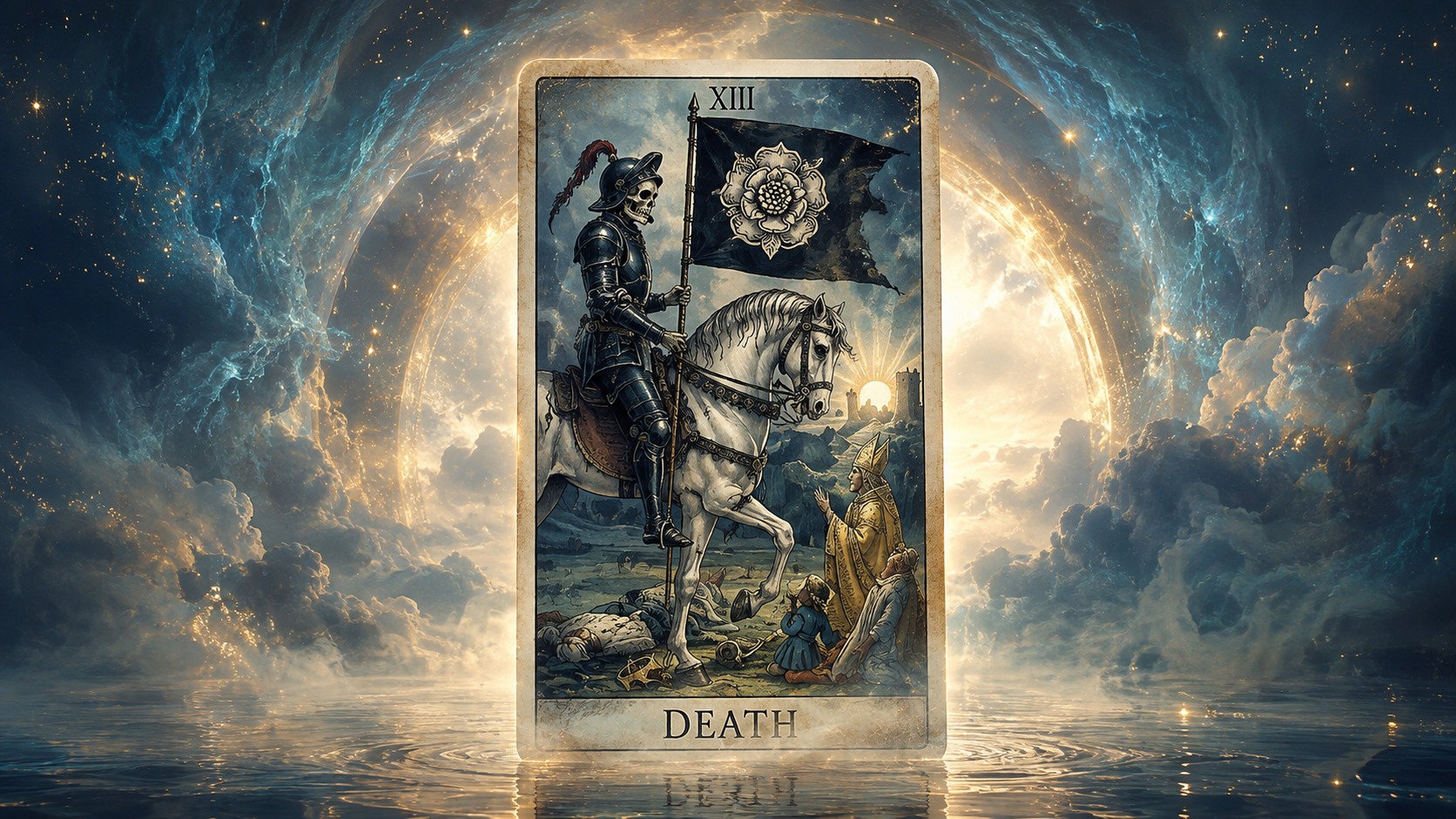
Tarot adds a useful complication because card XI changes identity depending on the lineage. In the older Marseille arrangement, XI is Strength, or La Force, while Justice occupies VIII. Arthur Edward Waite reversed those positions in the Rider-Waite-Smith deck, making Strength VIII and Justice XI.
The result is that eleven can meet two very different archetypal images inside tarot history. In one lineage it carries the woman mastering the lion and the language of strength. In another it carries the scales and sword of Justice. The number remained the same while the symbolic figure attached to it changed.
The master number 11
Modern numerology gave eleven one of its most influential identities. By 1926, Ariel Yvon Taylor was explicitly calling 11 and 22 master numbers and instructing readers not to reduce them in the ordinary way.
Taylor’s description of 11 is remarkably close to many themes that still surround the number today. She associates it with inspiration, psychic sensitivity, original ideas and the communication of higher truths. Elsewhere in the same book she describes the passage into 11 as a new beginning in a larger field of activity, where knowledge gathered through earlier stages becomes available through inspiration.
Her system also gives the individual digit 1 a clear character. One represents originality, individuality, intuition, independence and creative initiative. Two represents duality, receptivity and cooperation. Eleven therefore sits in an unusual position. It is kept intact as a master number, yet it is visibly made of two ones and those two digits also sum to two.
That structure allows modern numerology to read several levels at once. The doubled one intensifies themes of individuality, initiative and beginning, while the underlying two introduces polarity, relationship and the encounter between two sides. Eleven is one and one standing together, and at the same time it contains the movement from two units toward a single compound number.
The rise of 11:11
The spiritual life of 11 changed again when the number became a time.
By the late twentieth century, 11:11 was developing an identity distinct from the older symbolism of eleven. In 1992, Solara published 11:11 Inside the Doorway and built an entire spiritual framework around what she called the 11:11 Doorway. Her work described 11:11 as a gateway associated with movement from duality toward oneness and with a sequence of eleven gates.
Uri Geller also became closely associated with the modern 11:11 phenomenon. He has described being repeatedly drawn to clocks showing 11:11 and later used the sequence as a symbol of a gateway between realities. Through books, interviews, television and his public website, the number reached audiences far outside specialist numerology circles.
By the 1990s, 11:11 was therefore already circulating as a spiritual sign, a doorway and a synchronistic pattern. The clock had turned an abstract number into an everyday encounter. People did not need to calculate a birth date or name to meet it. They could simply look up and find it waiting on a digital display.
This modern 11:11 culture also gave the number a distinctive rhythm. It could appear repeatedly in ordinary life, then become memorable because of the circumstances surrounding the sighting. That made it especially compatible with the language of synchronicity that had entered twentieth-century spiritual thought.
From 11:11 to angel numbers
Doreen Virtue entered this story after 11 and 11:11 already carried several layers of symbolism. Her angel-number system gave repeating sequences a specific angelic vocabulary, while her interpretation of the 1-series connected 1, 11, 111 and 1111 with focused thought, manifestation and an opening of energy.
That modern reading did not arrive in an empty space. The number one already carried centuries of associations with origin, unity and initiative. Eleven already existed as a master number linked with inspiration and psychic sensitivity. Crowley had given it an explicit magical status, while Solara and Geller had already helped turn 11:11 into a modern spiritual gateway.
Virtue’s angelic interpretation added another layer to a symbol that had already been gathering meanings for a long time. The broader history of how angel numbers were systematized belongs to Where “Angel Numbers” Really Came From. In the specific case of 1111, the important point is that the angel-number meaning joined an older story rather than beginning it.
The eleventh hour
There is also a powerful historical repetition attached to eleven that has nothing to do with numerology books. The Armistice that ended the major fighting of the First World War took effect at 11 a.m. on November 11, 1918, the eleventh hour of the eleventh day of the eleventh month.
That sequence became embedded in public memory. November 11 developed into Armistice Day and Remembrance Day in many countries, while the United States later renamed the federal holiday Veterans Day. Every year, the calendar returns to 11/11 as a date connected with the end of one of the defining conflicts of the twentieth century.
For a number already associated in different traditions with boundaries, transition, excess, inspiration and the step into a new cycle, the historical weight of the eleventh hour added another remarkable layer to its cultural life.
The many lives of 1111
The modern meaning of 1111 is easier to understand when the sequence is viewed as the meeting point of several older ideas rather than as a symbol invented all at once.
One carried the language of unity, source and beginning across philosophy, religion and esotericism. Eleven became the number immediately beyond ten, first read by Augustine as transgression and later by numerologists as entry into a larger cycle. Crowley made 11 a number of Magick. Modern numerology made it a master number associated with inspiration and psychic sensitivity. Tarot gave XI different faces through Strength and Justice. The twentieth century then transformed eleven into 11:11, a repeated time associated with gateways, synchronicity and spiritual attention, before angel-number literature placed it inside an explicitly angelic system.
That is why 1111 carries more than one meaning today. It brings the old symbolism of unity into a fourfold repetition, it can be read as two elevens, it became a modern doorway and an angel number, it appears as a synchronistic time, and the sequence also has an extraordinary place in twentieth-century history. Different traditions have looked at the same number and found different doors inside it.
Sources
- Stanford Encyclopedia of Philosophy, Pythagoreanism
- Stanford Encyclopedia of Philosophy, Plotinus
- Sefaria, Deuteronomy 6.4 and the Shema
- Quran.com, Surah Al-Ikhlas 112.1
- Chinese Text Project, Dao De Jing chapter 42
- Jewish Encyclopedia, Kabbalah and Keter
- St. Augustine, The City of God, Book XV
- Aleister Crowley, Magick in Theory and Practice
- Library of Congress, Ariel Yvon Taylor, Numerology Made Plain, 1926
- A. E. Waite, The Pictorial Key to the Tarot
- Open Library, Solara, 11:11 Inside the Doorway, 1992
- Uri Geller official site, material on 11:11
- Google Books, Doreen Virtue, Healing with the Angels, 1999
- Google Books, Doreen Virtue, Angel Numbers, 2005
- Library of Congress, World War I Armistice
- National Archives, Armistice Day 1918