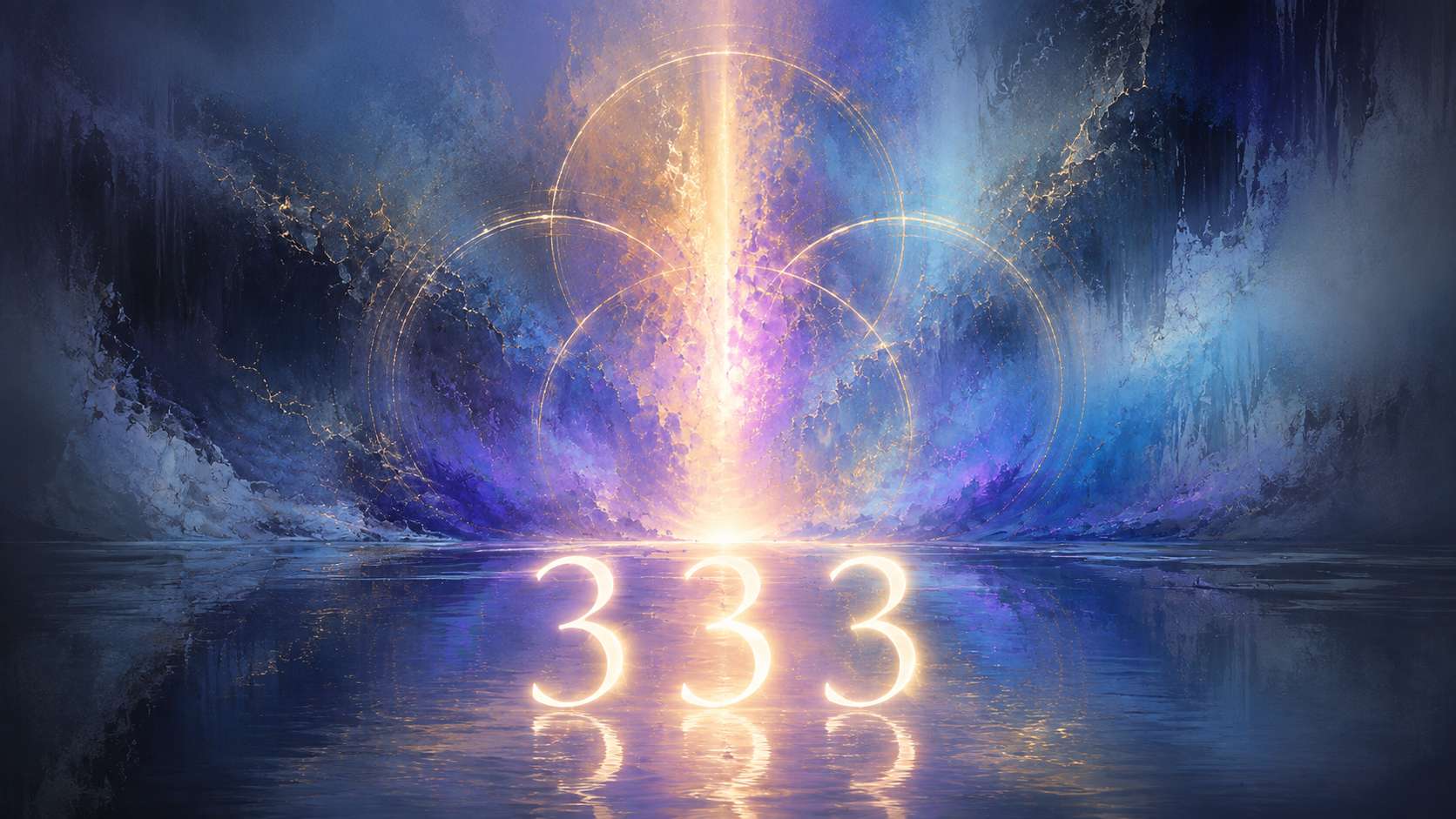
In numerology, 333 is also read through the symbolism of 3 and through its reduction to 9, while the sequence itself sits at the end of a much longer story in which 3 and 33 had already gathered meanings around completeness, expression, devotion and spiritual development.
That makes the meaning of 333 more interesting than a simple dictionary entry, because understanding why people attach meaning to it requires following the number backwards from 333 to 33 and then to 3, where many of the older symbolic associations begin.
The wider history of angel numbers themselves is covered in Where “Angel Numbers” Really Came From, while this article stays with the number and with the traditions that made three, thirty-three and finally 333 worth noticing.
The number 3 before 333
Three has been associated with wholeness for a very long time, and Aristotle, writing in the fourth century BCE, reports a Pythagorean idea that beginning, middle and end form the structure of an entire thing, adding that three is the first number to which people properly apply the word all because one thing is singular, two things are both, and with three the sense of a complete set appears.
There is also a simple geometric reason why three feels different from one and two, because one point gives position, two points can define a line, and three points, as long as they do not fall on the same line, can enclose the first polygon, the triangle, so the third element does not simply add another unit but can turn a relation between two points into a form.
This is one reason the triad became such a useful symbol, since one can represent unity, two can introduce contrast, polarity or relationship, and three can hold both sides while adding a third term that changes the structure, which in later symbolic language often becomes creation, mediation, expression or completion.
The symbolism of three across cultures
Religious and mythological traditions use groups of three so often that the pattern is difficult to miss, even though the groups do not all mean the same thing.
Christianity places a triune structure at the centre of its theology through Father, Son and Holy Spirit. Hindu theology developed the Trimurti, bringing Brahma, Vishnu and Shiva into a threefold scheme of creation, preservation and destruction. Ancient Egypt repeatedly represented divine triads, including Osiris, Isis and Horus, and surviving objects show these three deities together as a single devotional group.
Greek mythology is filled with threes as well. The Moirai or Fates are commonly represented as Clotho, Lachesis and Atropos, while other traditions gave the Greeks the three Graces and the three Furies. Norse mythology has the three principal Norns, figures connected with fate. Early Irish literature is especially rich in triads, and scholars have identified entire collections in which laws, sayings and observations are arranged in groups of three.
These traditions do not present themselves as one shared doctrine, yet what repeats is the usefulness of three as a way to organize a complete relationship, whether that relationship is beginning, middle and end, creation, preservation and destruction, or three figures who together govern fate, because a triad can feel finished while still containing movement inside it.
The same instinct survives in storytelling, where folktales give characters three wishes, three tasks, three brothers or three attempts, and a pattern appears, repeats and then resolves on the third turn, making the number a rhythm as much as a quantity.
Three in Kabbalah, alchemy and Tarot
Later esoteric systems continued to give three important roles, although they did so in very different ways and attached the number to different ideas.
In Kabbalah, Binah is the third sefirah and is associated with understanding, and together with Keter and Chokhmah it belongs to the upper group of three sefirot, while later Kabbalistic symbolism often presents Binah through maternal imagery as the principle that receives and develops what begins as wisdom.
Paracelsian alchemy organized matter through three principles known as the tria prima, sulphur, mercury and salt, which were not treated simply as the ordinary substances found on a shelf but as principles whose different combinations helped explain the properties and transformations of material things.
Tarot gives another resonance through card III, the Empress, in the Rider-Waite-Smith deck, where A. E. Waite describes her through fertility, fruitfulness and the visible world of generation, so although the card does not provide an ancient definition of the number three, its imagery shows how naturally three became linked with bringing something into form.
Modern numerology made that connection even more explicit, and in L. Dow Balliett's The Philosophy of Numbers, published in 1908, the person associated with 3 is described as expressing the two preceding vibrations, 1 and 2, while Balliett repeatedly connects 3 with expression and places art, music and the outward communication of inner qualities inside that field.
This creates one of the clearest historical bridges between the older idea of the triad and the modern language of creativity and communication, because three no longer merely completes a set but becomes the stage at which something held inside can be expressed outside.
When three becomes thirty-three
Thirty-three has a different history because it appears in several traditions without depending on modern angel-number culture.
Christian tradition has long associated Jesus with an age of about thirty-three at the Crucifixion, although the Gospels do not give that age as a single statement and the association instead comes from combining Luke's description of Jesus as about thirty when his ministry began with a ministry traditionally understood to have lasted several years, after which thirty-three became attached to ideas of completed earthly ministry, sacrifice and spiritual fulfilment.
The Hebrew Bible gives another direct appearance of the number, since First Kings says that David reigned for forty years in total, with seven years in Hebron and thirty-three years in Jerusalem, making thirty-three part of the biblical narrative itself rather than a later numerical interpretation.
In Islam, thirty-three enters daily devotional practice in a particularly concrete way through a well-known hadith that instructs worshippers after prayer to glorify God thirty-three times, praise God thirty-three times and magnify God thirty-three times, followed by a final declaration that completes one hundred, so the number is encountered through repeated prayer, memory and rhythm rather than through abstract numerology.
Dante also built thirty-three into the architecture of the Divine Comedy, with Purgatorio and Paradiso containing thirty-three cantos each while Inferno has thirty-four because its opening canto also serves as an introduction to the entire poem, bringing the full work to one hundred cantos and reinforcing Dante's wider use of three, the Trinity and the poem's three realms.
Master Number 33 and the idea of mastery
Thirty-three also gained an initiatory and numerological life, which added another set of meanings to a number already present in religion, literature and devotional practice.
The Scottish Rite of Freemasonry is organized through thirty-three degrees, and its own official material states that it acknowledges no degree higher than the thirty-third. That structure helped give 33 a public association with culmination, initiation and hidden knowledge, especially once Freemasonry became a subject of wider fascination.
Modern numerology did not arrive at the present treatment of 33 all at once, because an early edition of Ariel Yvon Taylor's Numerology Made Plain names only 11 and 22 as master numbers, while by 1956, in Numerology, Its Facts and Secrets, Taylor and H. Warren Hyer explicitly list 11, 22 and 33 as three higher numbers associated with mastery and describe 33 through spiritual consciousness developed through experience and a desire for a higher plane of service.
Later numerology expanded the idea further, and Faith Javane's 1997 book Master Numbers examines 11, 22, 33 and additional repeated master numbers, while contemporary numerology often calls 33 the Master Teacher and reads it together with its reduced value of 6, bringing themes of care, responsibility and service into the interpretation.
That history matters because the modern status of 33 is not simply an ancient rule handed down unchanged, but something that developed inside numerology as different writers added new layers and gave the number a progressively more defined identity.
How 333 acquired meanings of its own
Three and thirty-three both have long histories, while the surviving historical record looks different for 333 because its strongest identifiable traditions emerge much later and do not all point in the same direction.
One Christian route comes through Jeremiah 33:3, where the verse begins with God's invitation to call and continues with the promise of an answer and the revelation of things not yet known, and modern devotional culture sometimes treats the chapter and verse reference itself as a memorable numerical sign so that the digits become part of the way the passage is remembered.
Western ceremonial magic gave 333 another identity in the early twentieth century, and this reading is dramatically different from the reassuring meaning later attached to the angel number.
Crowley, Choronzon and the number 333
In Aleister Crowley's The Vision and the Voice, the number 333 is connected with Choronzon, a figure associated with the Abyss, fragmentation and dispersion, and Crowley's notes calculate the name Choronzon as 333 through gematria while also connecting the same number with Greek words he translates through ideas such as lack of control and dispersion.
The symbolism is deliberately disruptive, and in the record of the Tenth Aethyr, Choronzon is described through the breaking apart of unity, uncontrolled images and the inability to hold a centre, while Crowley later used 333 as the number of The Book of Lies, published as Liber CCCXXXIII.
This gives 333 a genuine occult history before the modern angel-number system, although the meaning is almost the reverse of the one that dominates popular spiritual culture today, since Crowley's framework links 333 with dispersion while later angel-number practice turns it into a sign of nearby spiritual assistance.
The meaning of 333 in the angel-number tradition
Doreen Virtue gives 333 a very specific meaning in her published number-sequence material, describing the sequence as a sign that the Ascended Masters are near and available to offer help, love and companionship. In her work, the term Ascended Masters refers to spiritually evolved teachers who are understood to have transcended ordinary physical existence, and she includes figures such as Jesus, Moses, Mary, Quan Yin and Yogananda among them.
That is more precise than the long lists now attached to 333 across the internet, where creativity, communication, growth, alignment, relationships and career advice are often added by later writers, while Virtue's core 333 message remains centred on the presence of Ascended Masters.
The older symbolism of three helps explain why later numerology could easily add expression and creativity to the sequence, because by the twentieth century 3 already carried those meanings in numerological writing, while repeating it three times makes the pattern visually and numerically emphatic and the angel-number system adds a separate spiritual message.
That makes 333 a layered symbol rather than one definition, with one layer coming from the long symbolic history of three, another from the modern development of 33, and a third from the specific angel-number vocabulary attached to 333.
333 numerology and the number 9
Numerology adds another layer because 333 reduces to 9 through simple addition, with three plus three plus three equalling nine.
Balliett's early numerology gives 9 a broad social and spiritual character, connecting its work with humanity, the unity of life and universal brotherhood, and she also describes 9 as holding three times the strength of 3, so within that system 333 can be read through both numbers at once, with three supplying expression and nine widening the field toward humanity, service and a larger whole.
This is different from calling 333 a master number, because in most modern numerology 333 is reduced normally to 9, while the master-number exception is usually applied to values such as 11, 22 and, in many later systems, 33.
The meaning of 333 across different traditions
The 333 meaning changes sharply depending on the symbolic system being used, because its modern interpretations come from separate historical lines that eventually meet around the same digits.
The number 3 brings a very old language of completeness, triads and the movement from unity into relationship and expression, while Master Number 33 adds a later numerological layer alongside Christian tradition, Islamic devotion, Dante's numerical architecture and Freemasonry, and 333 then develops further through Christian devotional use, Crowley's ceremonial magic and the modern angel-number tradition.
Taken together, 333 does not carry one single definition, because in Doreen Virtue's angel-number system it points to the nearby presence and support of Ascended Masters, in numerology it inherits the expressive qualities of 3 and reduces to 9, and in Crowley's system it takes on the strikingly different meaning of dispersion through Choronzon.
That is what makes 333 worth a closer look, since its modern popularity sits on top of a much older fascination with three while the sequence itself has gathered both comforting and disruptive meanings, so a person encountering 333 today may meet it through angel numbers, numerology, Christian devotion or ceremonial magic and each path opens a different part of the number's story.
Sources
- Aristotle, On the Heavens, Book I
- The Metropolitan Museum of Art, Triad of Osiris, Isis, and Horus
- Oxford Academic, Trimurti in Hinduism
- The British Academy, Fergus Kelly, Thinking in Threes and the Triad in Early Irish Literature
- Cambridge University Press, discussion of the Paracelsian tria prima
- Encyclopaedia Judaica, Kabbalah and the first three sefirot
- A. E. Waite, The Pictorial Key to the Tarot, The Empress
- L. Dow Balliett, The Philosophy of Numbers, Their Tone and Colors
- Bible Gateway, 1 Kings 2:11 and David's thirty-three years in Jerusalem
- Sunnah.com, post-prayer remembrance in sets of thirty-three
- Società Dante Alighieri, the numerical structure of the Divine Comedy
- Scottish Rite, Member Development Handbook and the Thirty-third Degree
- Ariel Yvon Taylor, Numerology Made Plain
- Open Library, Ariel Yvon Taylor and H. Warren Hyer, Numerology, Its Facts and Secrets
- Faith Javane, Master Numbers, Cycles of Divine Order
- Bible Gateway, Jeremiah 33:3
- Aleister Crowley, The Vision and the Voice, Tenth Aethyr
- Doreen Virtue, Angel Numbers, Google Books
- Doreen Virtue, Number Sequences From the Angels, archived publication