Death is the card filmmakers love to place on the table for an instant jolt, and it is often the card that unsettles new readers most. The clearest way to understand it is to follow the card through its own history: from a fifteenth-century Italian game piece with no documented divinatory meaning, through the occultists who gave it a symbolic language, to the Rider-Waite-Smith image most people recognize today.
That history reveals something important. The modern Death tarot card meaning was not built around a prediction that somebody will die. It was built around a much older esoteric idea: forms end, cycles close, and transformation requires something to be left behind.
What is the Death card, and where does it come from?
The Death card is card XIII among the tarot trumps, today usually grouped within the Major Arcana. Its documented history begins in fifteenth-century northern Italy, where tarot was created for play. The Metropolitan Museum of Art dates surviving Visconti-Sforza cards, including a Death card, to around the middle of the 1400s. At that stage tarot was a courtly card game, not yet the divinatory system familiar today.
The image of Death itself was not strange in Renaissance Europe. Medieval and early Renaissance visual culture was full of reminders that death levels kings, clergy, merchants, and ordinary people alike. The Danse Macabre and Triumph of Death traditions used skeletons, corpses, processions, and reaping imagery as visual meditations on mortality. A Death figure therefore belonged naturally among the social, moral, religious, and allegorical images of the early tarot trumps.
Later French decks in the Tarot de Marseille family made the image especially stark. XIII commonly shows a skeleton or skeletal figure sweeping a scythe across a field scattered with severed heads, hands, and feet. In a number of Marseille patterns, the card is numbered but left without a printed title, which helped produce the later idea of the card as a nameless arcanum. But the important distinction is chronological: the picture existed before the divinatory interpretation we now attach to it.
When did the Death card start to mean something in divination?
The divinatory meaning developed much later, during the rise of French cartomancy in the eighteenth century. Jean-Baptiste Alliette, better known as Etteilla, published a systematic method of fortune-telling with ordinary playing cards in 1770. That text gives us the earliest clear printed example of a system in which the same card can carry one meaning upright and another when reversed.
That does not prove that Etteilla was the first person in history ever to turn a card upside down and interpret it differently. Oral practices leave poor records. What we can say is that Etteilla is the earliest clearly documented author who systematized upright and reversed meanings in print.
Tarot entered his work after the occult reinterpretation of the deck accelerated in France. In 1781 Antoine Court de Gébelin argued that tarot preserved ancient Egyptian wisdom. The Egyptian origin story was historically mistaken, but it changed the cultural status of the cards. Between 1783 and 1785 Etteilla published a multi-part method devoted specifically to tarot, and material associated with his Livre de Thot tradition in the 1780s represents the first tarot explicitly designed around fortune-telling rather than game play.
From that point onward, the thirteenth card acquired a remarkably stable esoteric direction. Different occultists used different language, but destruction, change, regeneration, transition, and rebirth repeatedly appear around XIII.
Why does the Death card mean transformation rather than dying?
Éliphas Lévi, one of the most influential nineteenth-century occultists, linked tarot to Hebrew letters, number symbolism, and a larger system of ceremonial magic. In his writings, thirteen is connected with death because it follows the completed cycle of twelve, while death itself is tied to renewal and transition. His work helped establish the habit of reading the card, its number, and its esoteric correspondences together rather than treating the illustration as an isolated picture.
Papus, writing later in the nineteenth century, described the thirteenth arcanum through the logic of destruction and regeneration. The Hermetic Order of the Golden Dawn gave XIII the title “The Child of the Great Transformers: the Lord of the Gates of Death,” and associated it with the Hebrew letter Nun and Scorpio. The language is dramatic, but the key word is transformers: the card marks a gate through which one condition becomes another.
A. E. Waite made the same idea explicit in The Pictorial Key to the Tarot. For him, the visible mask of life continues through change, transformation, and passage. That is why his version of Death does not simply show a skeleton cutting people down. It stages a transition.
By the time the Rider-Waite-Smith deck appeared in 1909, the association between XIII and transformation was already deeply established. Modern readers did not invent that interpretation to make a frightening card more comforting. They inherited it from the occult systems that built the modern language of tarot.
Who created the Death card most people picture today?
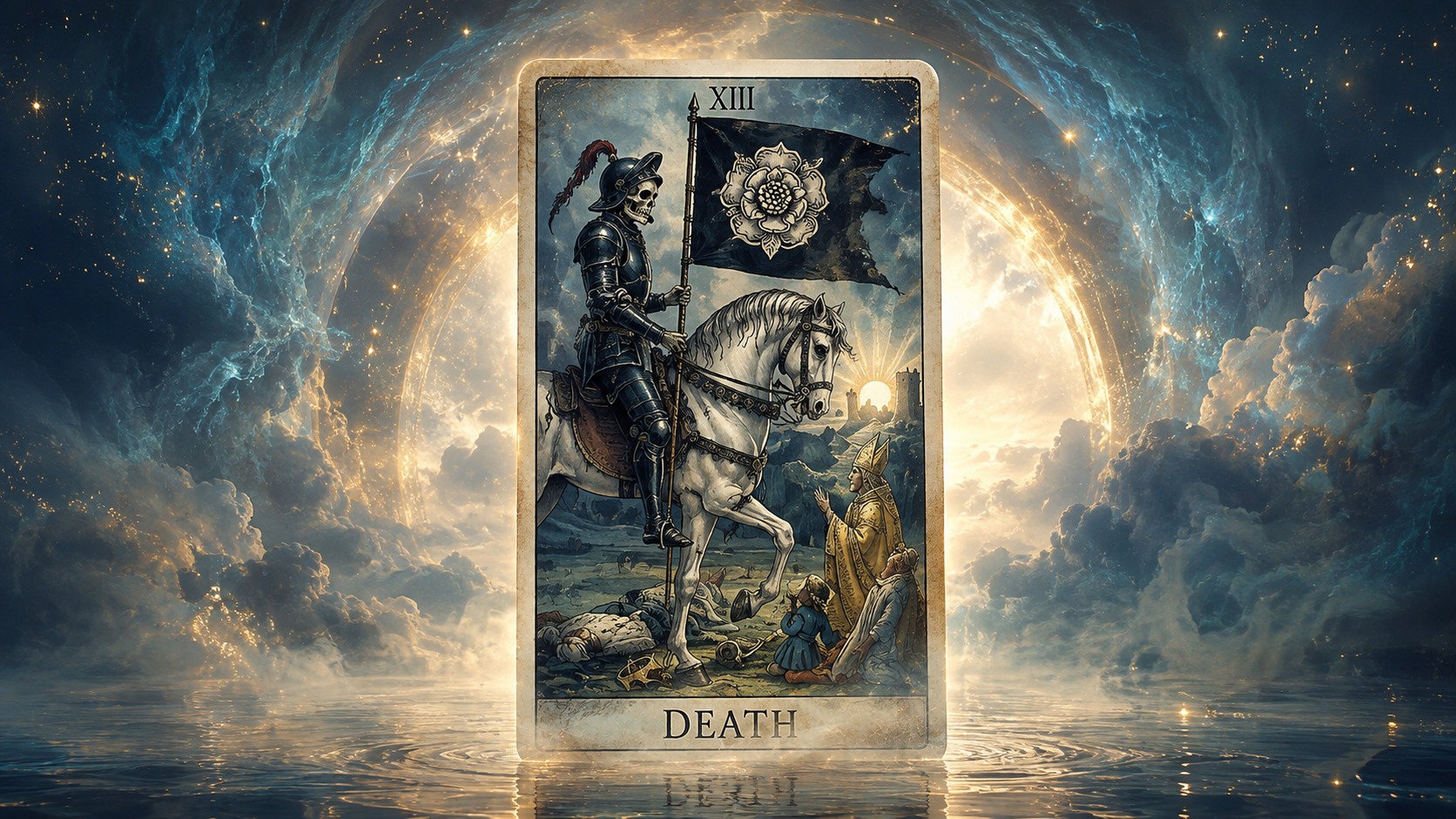
The image most people recognize today was created by artist Pamela Colman Smith for the deck developed with A. E. Waite and first published in 1909. The Victoria and Albert Museum identifies Smith as the designer of the deck’s imagery and notes that Waite gave detailed symbolic instructions for the Major Arcana while Smith created the visual language that made the pack enduringly influential.
For Death, the old Marseille scythe is gone. Smith shows a skeleton in black armour riding a pale horse. The rider carries a black banner marked by a white rose. A king lies fallen. A religious figure faces the rider. A woman turns away, while a child remains close to the horse. In the distance, between two towers, a sun rises.
Those choices change the emotional structure of the card. The rider is unstoppable, but he is not presented merely as an executioner. The white rose introduces life into the black banner. The rising sun places continuity on the horizon. The fallen king shows that status cannot stop change, while the figures who remain standing show different human responses to what cannot be prevented.
The result is not a picture of annihilation. It is an image of passage. Something is ending, and the card refuses to pretend that ending is optional, but the horizon is not empty.
What does the Death tarot card mean today?
Today, the core Death tarot card meaning is a necessary ending and the transformation that follows it. Something has reached the point where it cannot continue in its present form. The card asks what must be released, completed, abandoned, or allowed to die symbolically so that movement can resume.
The important word is context. Tarot does not operate by taking one keyword and applying it identically to every question. Death names the ending, but the question tells you what is ending.
If someone asks, “Is this relationship over?” Death can indicate that the relationship, at least in its present form, has completed its cycle. If the question is about work, it may point to leaving a role, a company, or an identity built around a career. If the question is “What is next for me?”, Death may describe the uncomfortable space in which an old life has already ended but the new one has not fully formed.
The neighbouring cards reinforce that movement. In the Rider-Waite-Smith sequence, Death stands after the Hanged Man and before Temperance. The Hanged Man suspends action and changes perspective. Death ends the old configuration. Temperance then recombines what remains into a new balance. Read as a sequence, the three cards describe surrender, transformation, and integration.
Can the Death card ever refer to an actual death?
A tarot card can appear in a consultancy concerning bereavement, illness, ancestry, grief, or an actual death because those subjects are part of human life. That is different from treating XIII as a standalone prediction that somebody is going to die.
A responsible interpretation begins with the question, the surrounding cards, and the context of the consultancy. A single Death card does not need to be sensationalized. Its primary symbolic function is much broader: endings, transition, irreversible change, release, and the transformation of one condition into another.
That distinction is particularly important because the visual force of the card can frighten someone before the consultancy has even begun. The image is supposed to be powerful. Power is not the same thing as literalism.
What does the Death card mean reversed?
Reversed cards do not simply mean the opposite of their upright meanings. The earliest clearly documented systematic use of reversals comes from Etteilla’s 1770 cartomancy, where reversing a card could create a distinct second meaning rather than a neat antonym.
Waite’s own reversed meanings for Death included inertia, sleep, lethargy, and destroyed hope. Modern readers often translate the same underlying idea into resistance to transformation: refusing to release what has ended, delaying an unavoidable change, or remaining psychologically attached to a form that no longer has life in it.
That is why reversed Death can sometimes feel heavier than upright Death. Upright, the ending is moving. Reversed, the person may be trying to stop the movement.
What is the meaning of the number 13 in the Death card?
For an occultist or a tarot reader who works with numerology, XIII is not decorative. The number is part of the card.
Éliphas Lévi explicitly connected thirteen with death because thirteen follows the completed cycle of twelve. That idea matters because twelve is one of the strongest cycle numbers in Western symbolic thought: twelve months complete the year, twelve signs complete the zodiac, twelve hours complete the traditional half-day, and twelve apostles form the complete circle around Christ in Christian symbolism. Twelve closes a structure. Thirteen is the step that comes after the structure has completed itself.
Seen that way, XIII is a remarkably appropriate position for Death. The card does not sit inside the completed twelve; it comes immediately after it. Something has reached fullness, and the next step cannot simply repeat the completed pattern. The form has to break, transform, or begin again.
We do not have a fifteenth-century designer’s note saying, “I placed Death at thirteen because twelve is completion and thirteen is transformation.” Early tarot developed over time, and surviving evidence does not let us identify a single mastermind who fixed every symbolic relationship at once. But later occultists did not treat the alignment as accidental. They read the number and the image together, and Lévi made the connection explicit.
For a reader working within that esoteric framework, the convergence is difficult to ignore. XIII follows XII; Death follows the suspended Hanged Man; and the card itself becomes the rupture between a completed condition and the possibility of another one. Whether that relationship was intentionally engineered at the very beginning or became fully conscious as the tradition developed, the symbolic fit is unusually strong.
This is why the number thirteen adds depth to the card rather than merely making it frightening. Numerologically, it says the same thing the image says: the completed form cannot remain as it is. A threshold has been crossed.
The card the reader hands you
The Death card is one of tarot’s clearest examples of how an image can be more frightening than its actual language. A skeleton appears, but the tradition reads transformation. A king falls, but the sun rises. A black banner is carried, but a white rose grows on it. The card is uncompromising about endings because an ending that is not accepted cannot become a beginning.
So if XIII appears in a consultancy, the useful question is usually not “Who is going to die?” It is “What has reached the end of its form?” A relationship, a job, a belief, a role, an identity, a habit, a period of waiting, or an entire way of organizing your life may be what the card is naming.
Death does not promise that transformation will feel comfortable. It says that transformation has become necessary. The scythe of the older decks became a banner; the banner carries a rose; beyond the rider, the sun is still rising. Something closes. Space opens. The next cycle begins.
Sources
- The Metropolitan Museum of Art — Before Fortune-Telling: The History and Structure of Tarot Cards
- The Metropolitan Museum of Art — The World in Play: Luxury Cards, 1430–1540
- Victoria and Albert Museum — A history of tarot cards
- The Warburg Institute — Tarot: Origins & Afterlives
- Wellcome Collection — Etteilla, Manière de se récréer avec le jeu de cartes nommées Tarots (1783–1785)
- A. E. Waite — The Pictorial Key to the Tarot, XIII. Death
- Éliphas Lévi — The History of Magic, including the number 13 and the completed cycle of 12
- Papus — The Tarot of the Bohemians, XIII. Death
- Israel Regardie — The Golden Dawn, Book T material on XIII Death